GPU support
What runs on a GPU today, on which backend, at what precision — the fGN family, the Euler engine, and everything else on the host.
Every process carries its sampling backend as a type parameter and is
re-typed with .on::<B>() (see backends). This
page is the inventory: which processes have a device kernel today, on which
backends, and what the rest do.
The support matrix
| Family | Processes | Capability bound | Cpu | Accelerate | Metal | Cuda |
|---|---|---|---|---|---|---|
| fGN noise | Fgn (1) | FgnBackend<T> | SIMD + ndrustfft | vDSP FFT | MSL FFT pipeline, f32 only | cuFFT + Philox, f32 / f64 |
| Sheet | Fbs (1) | SheetBackend<T> | SIMD + ndrustfft | same as Cpu | MSL sheet pipeline, f32 only | cuFFT + Philox, f32 / f64 |
| Euler engine, one component | 91 processes | EulerBackend<T> | the process's own SIMD sampler | same as Cpu | Euler–Maruyama kernel in MSL, f32 only | NVRTC kernel, f32 / f64 |
| Euler engine, systems | 39 processes | EulerBackend<T> | the process's own SIMD sampler | same as Cpu | the same kernel, up to four components | the same kernel |
| Euler engine, fractional | Fbm, Fou, Fcir, Fgbm, FJacobi, FVasicek, Cfgns, Cfbms, Cfou, JumpFou, JumpFOUCustom (11, counted above) | EulerBackend<T> | the process's own SIMD sampler | same as Cpu | fGN pipeline feeds the same MSL kernel | fGN pipeline feeds the same NVRTC kernel |
Every process reaches a device: Fgn and Fbs through pipelines of their own, the other 130 through the engine. The 130 processes on the engine cover the diffusions, the stochastic-volatility
models under both their Euler and quadratic-exponential schemes (Heston,
HestonLog, DoubleHeston, Heston2D, Sabr, Bergomi,
HestonStochCorr, BatesSvj, Hkde), the short-rate models including the
curve-driven ones (HullWhite, HullWhite2F, HoLee, BlackKarasinski,
CirPlusPlus, Cir2F, DuffieKan, DuffieKanJumpExp, Vasicek,
FVasicek), the fractional processes, the jump models (MjdLog, BatesSvj,
Hkde, HawkesJD, DuffieKanJumpExp, and the ones generic over a
user-supplied size law — Merton, Kou, LevyDiffusion, Bates1996,
JumpFou, JumpFOUCustom — whose ScalarNormal or ScalarExp law the
engine recognises at runtime and draws in the kernel, Bates's as the product
∏(1 + y) − 1 its multiplicative jump needs; any other law keeps the process
on the host through the same calls), the Lévy processes whose increment
is one draw with no rejection (Ig, Nig, IGSubordinator,
PoissonSubordinator, AlphaStableSubordinator, GammaSubordinator,
TemperedStableSubordinator, Vg, BilateralGamma, BilateralGammaMotion,
Bns), the discrete-time conditional-variance models at order (1,1)
(Arch, Garch, GjrGarch, Agarch, Egarch), the first-order lag models
(ARp, MAq), the noise generators (Wn, Gn, Cgns, Cfgns), the
correlated fractional pair (Cfbms, Cfou), the bounded correlation
processes (TengSCP, VanEmmerich, TransformedOU), the two models whose
coefficients travel as curves rather than parameters (MultifactorSabr's
term structure, Hjm's six time-dependent coefficients), the matrix-valued
models whose rows are independent copies of one small family (Bgm's forward
rates, Adg's affine factors, WuZhangD's rate–variance pairs — one launch
per row), the Cholesky-correlated baskets of up to four streams (MultiGbm,
Mcgns — one launch, the factor folded into the family's ten lower-triangle
slots; a wider basket stays on the host whatever the backend), the one- and
two-factor MultifactorHeston (which rides the double-Heston family with a
zeroed second factor when it has one; three or more stay on the host), the
regime-switching diffusion with up to four regimes (the one-step transition
matrix is exponentiated once on the host and travels as cumulative
thresholds; five or more regimes stay on the host), the Riemann-Liouville
family under the Markov lift of its rough kernel (RlFBm, RlFOU,
RlBlackScholes, RlHeston, and Volterra's lift branch — the lift's node
states live in the kernel's own per-path arrays, see below; Volterra's
reference-convolution branch rides the history block instead, the kernel
tabulated on the grid as its weights), the two lift-stepped
Volterra models (VolterraSquareRoot, and GaussianPolynomialVolatility up
to eight coefficients) and the event-indexed processes in their count mode
(Poisson, CompoundPoisson, and CustomJt / CompoundCustom when their
inter-arrival law is the scalar exponential), one arrival per step, and the
models whose step reads their whole past through the history block — the
rough-volatility models with a memory integral (RoughHeston, FBatesSvj,
RoughBergomi), the linear fractional stable motion Lfsm, and the ARIMA and
SARIMA recursions at any order, run as the moving-average filter of their
innovations — each on the host's own scheme, for grids up to 512 points; and the
tempered-stable processes built from their shot-noise series (Cgmy, Cts,
KoBoL, Rdts), whose terms the series block draws per path and sums into the
grid cells they fall in, the host's sort replaced by addressing, again up to 512
points; and Hawkes in its count mode, one event per step by the exact
two-uniform recursion of Dassios and Zhao, the host's thinning loop replaced by
a closed form; Ctrw under exponential waits, whose arrivals per cell are the
Poisson count the kernels draw, with normal, Rademacher or symmetric-stable
jumps; and Lmm with up to four forwards in one launch, the spot measure's
drift coupling and the reset freezes written out over the four slots; and
InverseAlphaStableSubordinator, whose table block builds the direct stable
subordinator per path on its own grid — doubling the extent until it reaches
the horizon, as the host does — and reads the inverse clock off it by
interpolation at every step; and Svcgmy, CGMY under a CIR variance, whose
variance takes the exact square-root step — a non-central χ² as the square of a
shifted normal plus the frame's gamma draw — and whose series terms are sized
in the step of their own cell against the variance there, the one series
clause written live; and the two-dimensional Wishart process by its exact
Ahdida–Alfonsi step — the three maps of the law identity folded on the host,
two coordinate steps each a shifted normal's square plus the frame's central
χ² draw and a Gaussian move of the off-diagonal entry — at a degree of three or
more, where the path stays inside the cone and the host's rank-adaptive branch
is never taken; and MultivariateHawkes in count mode with two components and
one decay per target, as the superposition of each target's exact excess clock
(Dassios–Zhao) with the baselines' joint Poisson clock, the event being the
earliest of the three — the two extra uniforms come from the noise
components, half the sum of two squared normals being a unit exponential and
one minus its negative exponential a uniform. The two-dimensional field Fbs
is the one other device process off the engine: its sample is a transform, not a recursion, and it runs through a
pipeline of its own behind SheetBackend<T>, described below.
What stays on the host, and why. The engine steps a bounded forward recursion over four scalar state slots, so what rules a process out is unbounded work per step, unbounded state, or an output that is not a fixed grid:
- A history integral over every earlier step, on a grid longer than 512
points (
Volterra's reference branch and any history family above that length): the step sums(t_i - t_j)^(H - 1/2) z_jover allj < i, which is work that grows with the step index. The Markov lift is the answer where it applies — the wholeRl*family andVolterra's rough kernels ride it — and the history block runs the direct convolution itself, exactly as the host does, for grids up to 512 points; that is howRoughHeston,FBatesSvj,RoughBergomiandLfsmreach a device. Longer grids stay on the host, which the process'sdevice_ready()decides. - A variance with less than one degree of freedom (
Svcgmyat4κη/ζ² < 1): the exact square-root step then draws a Poisson mixture the kernels do not carry, and the process stays on the host; at one degree or more the step is the square of a shifted normal plus a central χ², which the frame's gamma draw supplies, and the series block sizes the terms live. - A runtime dimension that couples its rows, above the slots (
Wishartaboved = 2,Lmm/MultiGbm/Mcgnsabove four): the rows share a drift or a correlated noise, so they cannot be stepped as independent launches the wayBgm,AdgandWuZhangDare, and a launch carries four slots and four shocks; within them they ride one launch, above they stay on the host whatever the backend.Wishartalso stays below a degree of three, where its exact step may take the rank-adaptive branch — or, below two, the Poisson mixture — that a family does not express. - More time-varying coefficients than the eight the kernel binds: none
today.
MultifactorSabrneeded three,Adgfive andHjmsix, and all three now declare them — the first turned a per-step bucket search into a buffer read, the last seven time-only callables into six tabulated curves. - A coefficient written as a Rust closure or a Python callable
(
Cheyette'ssigma(t, x),VolterraSde's drift and diffusion,HestonSlv's leverage): a closure of time alone is tabulated as a curve the wayCir2F'sphi(t)is, but one that reads the state has no representation a kernel can evaluate, and neither has a coefficient tabulated as aGrid2D— a calibrated leverage surface, say. Written as anExprinstead —Expr::lit(0.01) + Expr::x().abs() * 0.4— the same coefficient compiles to a short program the kernel interprets, and the process runs on the device; see "Coefficients as expressions" below. - Point processes on their own clock (
HawkesandMultivariateHawkesin their horizon modes, andMultivariateHawkesabove two components or with per-pair decays): the output length is the number of events, not the grid.Hawkesin count mode is one event per step and reaches the engine through the exact exponential-excitation recursion, andMultivariateHawkesin count mode with at most two components and one decay per target by superposing each target's exact excess clock with the baselines' joint Poisson clock — per-pair decays make a sum of exponentials at different rates whose first arrival has no closed form, and a third component would need a fifth state slot, so both stay on the host;Ctrwis a grid process and reaches it under exponential waits, while its gamma, inverse-Gaussian and stable waits have no per-cell Poisson count and stay on the host.Poisson,CompoundPoisson,CustomJtandCompoundCustomsplit here — their count mode is a fixed-length running sum and reaches the engine, their horizon mode does not. - A per-step search over a table finer than 512 points
(
InverseAlphaStableSubordinatorwith moreu_stepsthan that): the table block keeps the direct subordinator in a per-path array of 512 values and scans it; a finer table stays on the host. - More regimes than the four the chain family carries
(
RegimeSwitchingDiffusionat five or more): the family holds four volatilities and four rows of thresholds; larger chains stay on the host whatever the backend. - A lag order above one (
ARp,MAqor the GARCH family built above order one): the recursion reads back as many past values as the order and a step holds four slots. At order one they reach a device; above it the process stays on the host, as itsdevice_ready()reports.ArimaandSarimaare the exception: a linear recursion of white noise is a moving-average filter, so the history block runs them at any order as the convolution of the innovations with the recursion's own impulse response. - A sheet whose embedding sides are not powers of two (
Fbswithm − 1orn − 1not a power of two): the sheet pipeline's radix-2 transforms take embedding sides2(m − 1)and2(n − 1)that are powers of two; any other grid stays on the host whatever the backend. - More variance factors than a launch's four shocks carry
(
MultifactorHestonatK >= 3): each factor takes two shocks, so one and two factors ride the double-Heston family and three or more stay on the host whatever the backend.
Coefficients as expressions
Cheyette, VolterraSde and HestonSlv take their coefficients as [Fn2D] callables of
time and state. A Rust closure or a Python callable runs on the host only —
nothing can evaluate it in a kernel — and the device build keeps such a
process on the host, bit-identically to the Cpu build. Written as an
[Expr] the same coefficient reaches the device:
use stochastic_rs::traits::Expr;

// σ(t, x) = 0.01 + 0.4 |x|, a displaced local volatility
let sigma = Expr::lit(0.01) + Expr::x().abs() * 0.4;
let cheyette = Cheyette::<f32, _>::new(f0, 0.5, sigma, 252, Some(1.0), seed).on::<Cuda>();
Expr::t() and Expr::x() are the time and the state, Expr::lit a
constant; the arithmetic operators, sqrt, exp, ln, abs, tanh,
powf, max and min build the tree — the vocabulary the engine's own
function table has, so every node means one thing on the host and in every
kernel. From<Expr> for Fn2D compiles the tree to a postfix [Program] of at
most 62 operations on a stack of at most 8, checked at compile time on the
host. The host evaluates that program wherever it would have called the
closure; a launch uploads it — two programs at most, [len₁, len₂, (opcode, constant)…] in one small buffer — and before every step the kernel runs
each program at the step's time and first state slot, handing the values to
the family as pv and pv2. The CheyetteLocalVol family reads its
volatility as pv, the HestonSlv family its leverage; the VolterraProgram family, which steps under the
kernel's Markov lift, reads its drift and diffusion as pv and pv2. Each
kernel — the C body CUDA and Metal render — carries the
same sixteen-opcode interpreter, and the parity suite runs a probe program
with every opcode in use through all of them against the host's Program::eval.
What a family is
A process reaches a device by declaring which of the engine's 121 families
it steps, not by writing a kernel. A family is one entry in
stochastic-rs-stochastic/src/euler/families.rs — its parameters, its state
components, its noise components, one step expression per component and one
report expression — and the same tokens generate the host step, the C body
the CUDA and Metal kernels render. Adding a process
is a declaration plus an EulerCoefficients (one component) or EulerSystem
(more than one) impl; no kernel is edited.
The engine's kernels carry four state slots, four independent noise
components, twenty scalar parameters, two uniforms, a Poisson jump count,
the sum of that step's jump sizes — under a normal, double-exponential,
tempered-stable, Rademacher or symmetric-stable law, the first two also
compounded as ∏(1 + y) − 1 for a multiplicative jump or taken one per step
for an event-indexed path — and up to two Gamma draws. A family with a lift clause runs under the Markov lift of a
rough Volterra kernel: the frame keeps up to 176 nodes' two state vectors per
path, evaluates the family's drift, diffusion and shock before the step and
hands it the lifted value as lv. A family with a history clause keeps, per
path, the values it pushes each step — up to 512 grid points — and reads their
convolution with a weight curve the launch tabulates, indexed by lag, as
cv: the exact O(n²) scheme of a moving average over the whole past, which is
a Volterra integral on the grid, an ARMA filter or a fractional stable motion
depending on the weights. A family with a series clause has the frame draw,
per path and before the steps, as many shot-noise terms as the launch names —
a unit-rate arrival, an exponential, two uniforms and an arrival time each —
size them with the family's own expression and sum them into the grid cells
their times fall in, up to 512; the step reads its cell as sj. A family with a
table clause has the frame build, per path, a monotone table of up to 512
values from its increment expression, doubling the extent until the table
reaches the horizon, and hands each step the interpolated inverse at its time
as iv. A launch may carry up to two programs — coefficients written as
Expr — which the frame evaluates before every step at the step's ct and
first state slot and hands to the family as pv and pv2. A launch binds up to eight time-varying coefficients, which
a family names ct and ct1 through ct7; it pays one buffer read per
declared curve per step, so a model with one still pays for one. The first
two noise components may come from a fractional pipeline instead of the
kernel's own hash stream: one embedding produces both when the rows share a
Hurst exponent, which is what a correlated fractional pair needs. A
process whose first grid point is itself a draw — a conditional-variance
model's series, a noise generator — asks the launch to step before writing
it. A model that wants correlated shocks draws the components independently
and correlates them in its own step, which is what the host samplers do.
Feature flags: metal (Metal), cuda (Cuda), accelerate
(Accelerate). A marker only exists when its feature is
compiled, so selecting a backend a process does not support — or one the
build does not carry — is a compile error, never a silent fallback. The same
holds for precision: the capability traits take the scalar
(FgnBackend<T>, SheetBackend<T>, EulerBackend<T>) and a device implements them only for
the precision its kernels compute in, so Gbm<f64> or Fgn<f64> on
Metal does not compile. Nothing is computed in f32
behind an f64 type.
What the device path does
- fGN noise. The circulant-embedding FFT that produces fractional
Gaussian noise runs on the device, one launch per
sample_parbatch.Fgnreturns it directly. - Programs. A coefficient written as an
Exprtravels to the kernel as postfix code and is interpreted before every step —Cheyette's local volatility,VolterraSde's drift and diffusion,HestonSlv's leverage — so the device runs the very same coefficient the host does, not a tabulation of it. - Sheets.
Fbsruns its two-dimensional circulant embedding as a pipeline beside the fGN one. The embedding's eigenvalue roots are computed once on the host, when the process is built; per batch the device draws the complex Gaussian noise, scales it, transforms the rows, transposes, transforms the columns and reads out the leadingm × nblock less its corner plus Stein's linear correction√(2c₂)(t₁Z₁ + t₂Z₂). The radix-2 transforms take embedding sides that are powers of two, so a grid withm − 1andn − 1powers of two runs on the device and any other stays on the host, bit-identically to theCpubuild. A batch produced in chunks equals one launch sheet for sheet, as with the fGN pipeline. - Fractional diffusions.
Fbm,Fou,Fcir,Fgbm,FJacobi,FVasicek,Cfgns,CfbmsandCfouhand those increments to the Euler engine, which runs the whole recursion in the kernel. They declare no kernel of their own:Fouis the same Ornstein–Uhlenbeck family a GaussianOuuses,Fgbmthe same geometric one, and a step that multiplies by an increment does not care whether the increment was hashed or produced by an FFT. The two kernels meet in device memory: the pipeline hands its own buffer to the Euler launch instead of reading the increments back, so a batch crosses the bus once, for the paths. Measured on an M-series Metal device against the host: fOU with 2000 paths of 512 steps went from 101 ms to 5.8 ms, fBM with 4000 paths of 1024 steps from 252 ms to 19.2 ms. Keeping the increments on the device is most of that: through host memory the same runs took 25 ms and 93 ms. - Euler engine. The whole Euler–Maruyama recursion of a path runs in one
kernel thread;
sample_par(m)is one launch for allmpaths,sample()launches a single path. A system writes one plane per component, so a Heston draw comes back as the two arrays it always did. CIR uses full truncation (Lord, Koekkoek & van Dijk 2010) in the kernel. The CUDA and Metal kernels are one C body rendered per language, soMetalandCudaagree with each other seed for seed up tof32libm rounding;euler::family_paritylaunches every declared family on the device present and holds it to the host step. - Host backends.
Cpuis the process's own sampler;Accelerateis a CPU device that only differs for the fGN family (vDSP FFT). For every other process both are the same code path.
Large batches
A device handle holds at most batch_budget bytes of path data per launch
(1 GiB by default, STOCHASTIC_RS_DEVICE_BATCH_BYTES, or
Cuda::default().with_batch_budget(n)). A larger sample_par(m) runs as
several launches whose union is bit-identical to one launch, because the kernels
hash the global path index; sample_map(m, f) maps each chunk in parallel on
the host before the next chunk is launched, so the batch never has to fit in
memory at once. On native CUDA the chunks alternate between two streams: one
copies back through pinned memory while the next computes. The fGN devices chunk
the same way, one seed per batch and an element offset per chunk, and keep the
FFT plans and buffers of the last four (n, m) shapes, so alternating two sizes
does not re-plan on every call.
More than one GPU
The handle names the device: Cuda::new(1) (CUDA ordinal),
Metal::new(1) (index into Device::all());
process.with_backend(handle) puts a process on that handle, .on::<B>() on
the backend's default handle, and handle.probe() reports the device opened.
The defaults read STOCHASTIC_RS_DEVICE and STOCHASTIC_RS_DEVICE_BATCH_BYTES.
From Python the name carries the ordinal: device="cuda:1",
probe_device("metal:0").
When the device is missing
handle.probe() on any backend handle returns Ok(DeviceInfo) with the device's name and
precisions, or Err(DeviceError) saying why it cannot be used (Unavailable,
Compile, Launch). Every process has try_sample() and try_sample_par(m)
on ProcessExt, returning the same error instead of panicking (always Ok on
the host devices, bit-identical to sample*); the plain sample* calls panic
with the error's message and never fall back to the host. From Python a device
failure is a RuntimeError.
A configuration the kernels cannot carry is a different matter and follows
one rule: the process samples on the host, bit-identically to the Cpu
build, whatever backend it is on, and device_ready() — a ProcessExt
method, true by default — says so beforehand. Nothing panics and nothing
changes law; the "What stays on the host" list above is exactly the set of
configurations that answer false.
Precision and reproducibility
| Backend | Precision | Same seed, same device | Bit-identical to Cpu |
|---|---|---|---|
Cpu | f32 / f64 | yes, thread-count independent | — |
Accelerate | f32 / f64 | reproducible-effort only (vDSP reduction order can differ across core types) | no |
Metal | f32 (an f64 process is a compile error) | yes | no |
Cuda | f32 / f64 (a failing f64 launch is reported, never replaced by the f32 kernel) | yes | no |
The device seed is drawn from the process's own seed source, so the device
follows the host's rule exactly: two processes built from the same
Deterministic seed value give the same paths, consecutive calls on one
process advance the stream into independent paths, and an Unseeded process
draws fresh entropy every call. Host and device
paths agree in distribution, not bit for bit, because the device draws its
own stream.
From Python
Every class whose process reaches a device takes device=
(PyGbm(..., dtype="f32", device="metal")), checked and probed at
construction. A class also answers device_ready() and device_fallback()
for the configuration it holds, so a device= that the kernels cannot honour
is visible rather than merely slow. PyGbm(0.05, 0.2, 253, x0=100.0, t=1.0, seed=7, device="metal", dtype="f32").sample_par(m) runs the Euler
engine with device one of "cpu", "accelerate", "cuda", "metal" —
every name is one concrete backend, there
is no "pick whatever is compiled" name; one the build does not carry raises
ValueError with a rebuild hint. The array is float64 from
the CPU and native CUDA paths and float32 from Metal, whose kernels
compute in single precision. The published wheels are
CPU-only; the device backends come with a source build —
maturin develop --features metal on a Mac,
--features cuda on an NVIDIA machine.
Trying the CUDA back-end without a CUDA machine
notebooks/colab_cuda_check.ipynb
opens in Google Colab: on a T4 runtime it installs Rust, clones the repository,
runs the native CUDA tests (the fGN pipeline and the Euler engine), builds the
Python wheel with device="cuda" and plots what the GPU produced. The
Rust tests build in 10–20 minutes on Colab's two cores, the wheel in another
ten; the tests and the plots take seconds.
A run on a T4
notebooks/runs/colab_cuda_check_T4_2026-09-03.ipynb
is the executed copy of a run on 2026-09-03 (Tesla T4, driver 580.82 / CUDA
13.0, toolkit 12.8; it predates the rename of the backend, so its cells,
its output and its handle names still read cuda-native / CudaNative;
GitHub's own viewer may not render Colab outputs,
nbviewer
does). All 12 native-CUDA tests passed, including the two that assert a
chunked batch equals one launch path for path, in f32 and f64; the wheel
built for CPython 3.13 and its device tests passed; probe_device reported
{'backend': 'CudaNative', 'name': 'Tesla T4', 'precisions': ['f32', 'f64']}
(the handle is Cuda and reports "Cuda" since the rename).
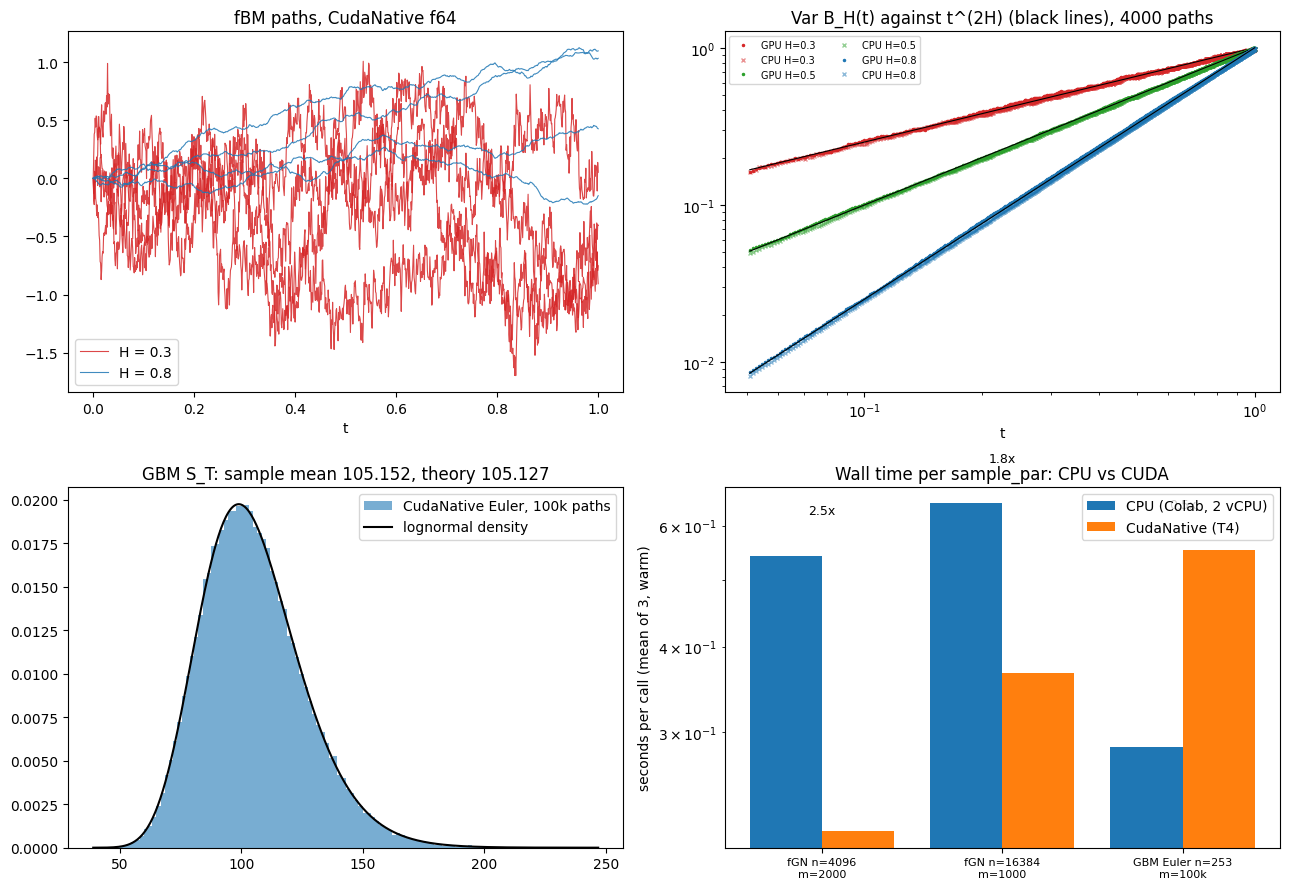
The variance of fractional Brownian motion sampled on the GPU sits on the
t^{2H} lines for H = 0.3, 0.5, 0.8 exactly where the CPU samples sit, and
the Euler engine's GBM terminal mean over 100k paths was 105.15 against the
105.13 forward. Wall time per call, warm, against Colab's two CPU cores:
| Case | CPU | Cuda (T4) |
|---|---|---|
fGN, n = 4096, m = 2000, f64 | ≈ 0.55 s | ≈ 0.22 s (2.5×) |
fGN, n = 16384, m = 1000, f64 | ≈ 0.65 s | ≈ 0.36 s (1.8×) |
GBM Euler, n = 253, m = 100k, f64 | ≈ 0.29 s | ≈ 0.56 s |
The Euler case is slower on the T4 in f64 because that card executes
double precision at 1/32 of its single-precision rate, and the 200 MB result
is copied back and re-laid as rows on the host; dtype="f32" is the setting
for the Euler engine on inference-class GPUs. The fGN pipeline is FFT-bound
and wins already at these sizes; the gap widens with m.
Adding a kernel
A process joins the Euler engine inside this crate: one family entry in
euler/families.rs — parameters, state, noise, step and report expressions,
plus a lift, history, series or table clause where the recursion needs
one — generates the host step, the C body the CUDA and Metal kernels render
and the process declares that family through the
engine's launch hooks and switches its backend_switch! line to via euler.
The hooks, the family specification and the slot caps are the engine's own
machinery: public so the crate's tests and probes reach them, hidden from
the rendered documentation and outside the stability promise. What is public
and stable is the capability a bound names, EulerBackend<T>, together with
.on::<B>(), with_backend(handle), device_ready(), probe() and the
try_* calls. Widening a process's bound from HostBackend to EulerBackend
is not a breaking change for its callers.
A coefficient a process takes as a closure has no representation a kernel
can evaluate; written as an Expr it compiles to a program the kernel
interprets, which is how Cheyette, VolterraSde and HestonSlv run on a device. Sde,
which drives its own loop over caller-supplied closures, is the one process
whose .on::<B>() re-types without changing where it samples.
Last updated on
Sampling backends
Compile-time device selection through `.on::<B>()` and `with_backend(handle)` — the `Backend` marker, its capability subtraits, one fallback rule.
Design philosophy
Why the library is shaped the way it is — generic over float, no statrs, paper-anchored implementations, comparison-test mandatory, plus non-goals.